Campaigning in a crowded field: what has changed since the summer
The local elections next May will be fought on ground that has shifted twice in a year. Reform and the Greens broke open the old two-party contest in May 2026, and then the summer rearranged the field again: Labour recovered under Andy Burnham, Reform slipped to third in the polls while banking more money than every other party combined, and the Green surge deflated. This article sets out what has changed, what the evidence says about both newer opponents, and what Liberal Democrat campaigners should do about it.
A different race
In May this looked like a Reform election. The monthly polling average had Reform on 27%, with Labour and the Conservatives tied on about 19%, the Greens on 14% and the Liberal Democrats on 12%. Six months later the order has turned over. PollCheck’s average on 18 November has Labour on 28.6%, the Conservatives on 22.7%, Reform on 21.1%, the Liberal Democrats on 9.6% and the Greens on 8.4%.
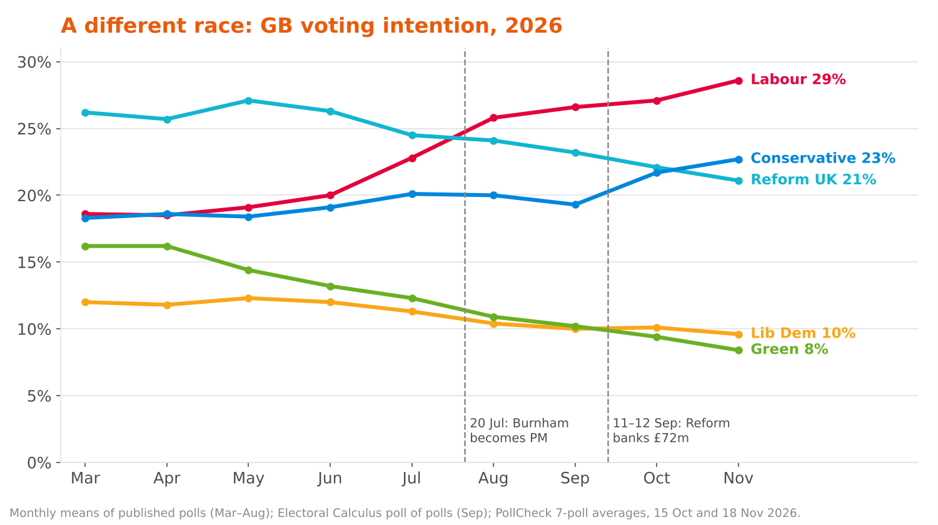
GB voting intention by month, March to November 2026. Monthly means of published polls to August; Electoral Calculus (September); PollCheck averages (October and November).
The turn came in July, and it was Andy Burnham rather than anything Reform did. Burnham won the Makerfield by-election on 18 June, Keir Starmer announced he was going four days later, and Burnham became Prime Minister on 20 July. From that month Labour’s line goes up and Reform’s goes down. YouGov now finds 60% of 2024 Labour voters back with Labour, against 38% in June. In other words, the voters who drifted to the Greens over the winter have largely gone home, and the Labour squeeze that we stopped running in the spring is back on.
Two things in that chart matter for anyone planning a local campaign. First, the race you planned for in May is not the race you are in. Second, Reform’s slide has nothing to do with money or organisation, both of which have got stronger over the same period.
Next May: a first for almost every seat
On 6 May 2027 there are elections in 215 English councils, including all 136 district councils, plus every council in Scotland and Wales. That is around 10,000 seats: about 8,000 in England, 1,226 in Scotland and 1,234 in Wales. Local government reorganisation was paused in September and the government confirmed on 29 October that the new unitary councils’ first elections move to May 2028, so the districts fight one more time.
Almost none of these seats has been fought against Reform as it now is. Most were last contested in May 2023, when Reform stood 471 candidates for 8,063 English seats, averaged 6% where it stood and won six seats, all of them in Derby. Scotland and Wales last voted in 2022. In May 2026 Reform stood in 99.9% of seats, and next year it will do so again with paid organisers in its target areas.
So the 2023 result in your ward tells you almost nothing about next May. Plan for a four- or five-way contest in wards that have only ever been two-way, and use the 2025 and 2026 results in neighbouring areas as your guide instead.
Reform: off the top, not off the pitch
Reform are a touch under where they were, not out of the race. Their polling average is about 22%, down from 27% in May and 31% a year ago, and two pollsters now put them third behind the Conservatives. They are holding on to 68% of their 2024 voters, against about 95% in May 2025, and 17% have gone back to the Conservatives. Farage’s net approval is around minus 30. They have lost more than 100 councillors since May 2026 through suspensions, resignations and defections, and their councils have put council tax up by as much as 5% with no DOGE savings to show for it.
Their by-election record has changed too. Since June they have held only 7 of the 21 seats they were defending and lost 14, including to us at St Neots and Almondbury. Where we campaign hard they go flat or backwards. Their gains still come, but in places where we are absent. And Restore Britain, polling between 2% and 9%, is now splitting their vote: it cost them Shepshed and Peterlee in October.
None of that means they are beatable without the work. At 22% they still win open Reform-demographic wards, and they still made 20 council by-election gains since June. Their record only becomes a weapon when voters hear it from someone they trust, locally and repeatedly.
The thing that has got stronger is the money. In one September weekend Reform took £72m from two donors, £36m each from Ben Delo and Christopher Harborne, the two largest gifts in British political history. Add the Electoral Commission’s figures for the first half of the year and Reform has raised about £87m in 2026 so far, against £22.8m in the whole of 2025. The Conservatives, Labour, the Liberal Democrats and the Greens together raised about £24m in the first six months. Reform’s stated target is £100m for the general election.
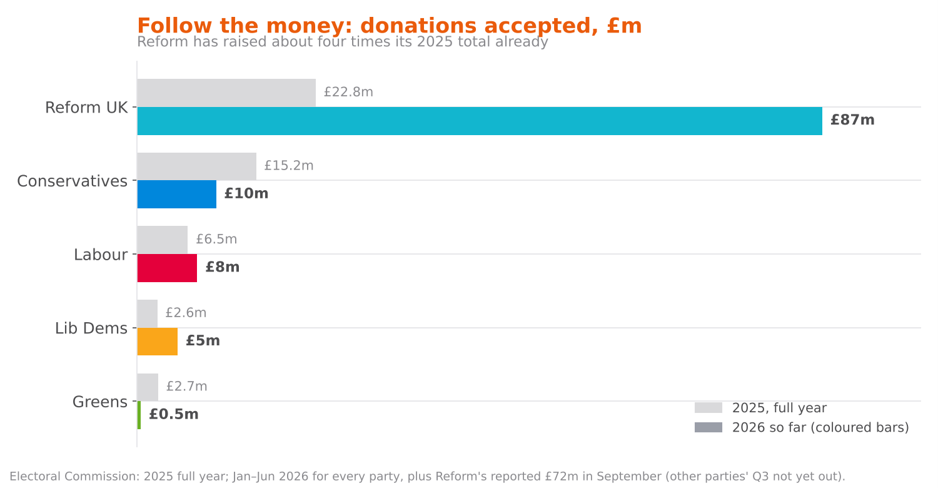
Donations accepted by party: 2025 full year against 2026 so far. Electoral Commission figures for January to June 2026 plus Reform’s reported £72m in September; other parties’ third quarter not yet published.
What the money buys on the ground
For the first time, Reform are building a paid field operation. In September they advertised 47 full-time campaign managers across Britain, senior campaign managers in every region, four branch network co-ordinators, two dedicated local by-election managers, a call-centre manager and a “councillor welfare manager” for their 2,300 councillors. The posts are weighted towards places where they have no base: the South West, the South East and London. Farage’s own description is “400 campaign managers in target constituencies” and a party “on a war footing for three years”.
The job description tells you what to expect. A campaign manager is to run a canvassing schedule that collects voting-intention data, organise the delivery of literature designed at head office, mobilise branch volunteers, identify local government candidates and run polling-day operations. It is explicitly not strategy, press or social media. So expect real canvass data and sharper by-election campaigns from Reform in their target seats, and expect paid delivery, phone banks and direct mail where before there was a Facebook page. They are already buying the letterbox: JICMAIL recorded political mail volumes about six times higher at the May 2026 locals than a year earlier, with Reform accounting for 27% of it.
What has not changed, yet, is the literature itself. It is still designed centrally and the content is national. There is no sign of local stories or action-style leaflets at the same quality as their national literature. The money makes that possible, so plan as if it will come, but our edge for now is local content and a record of action, and we should keep it. Their own activists are already complaining that they want door-knockers rather than managers, and whether the managers can recruit any is the question to watch.
The money also funds a media operation: The Reformer, an eight-page newspaper to 15 million households, a Westminster video studio and a newsroom of around 25 staff.
The Greens: the surge has deflated
The Green surge was a bubble, and it has largely gone. In August 2025, the month before Zack Polanski became leader, the Greens averaged 8.7% in the polls. Membership tripled to 230,000, they won the Gorton and Denton by-election in February, and the monthly average peaked at 16% in March and April, with single polls as high as 21%. It has fallen every month since. On 18 November the average is 8.4%, with pollsters spread from 7% (More in Common) to 11% (YouGov and Find Out Now). They end roughly where they started, which is why this is a floor rather than a collapse.
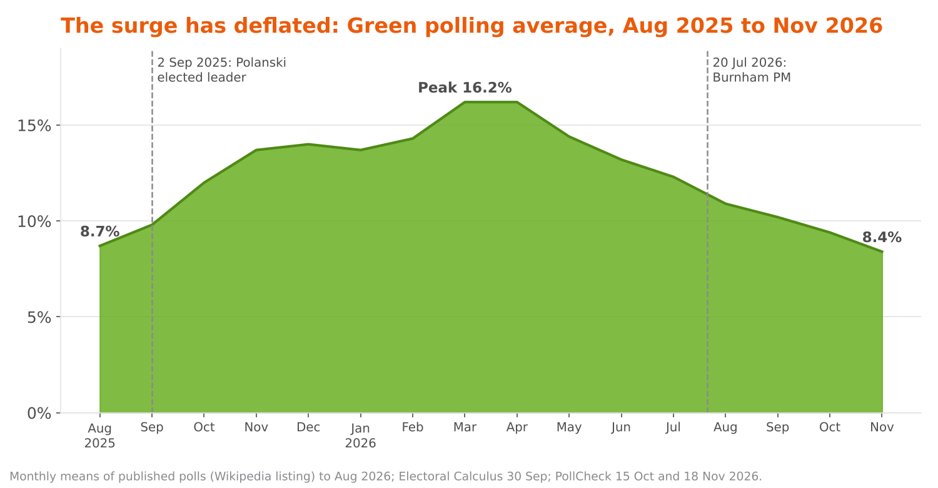
Green polling average by month, August 2025 to November 2026. Monthly means of published polls to August 2026; Electoral Calculus (September); PollCheck (October and November).
Most of the fall is Burnham, which the Greens cannot fix. More in Common finds Labour has halved the share of its voters it loses to the Greens, and Labour now leads among the “Progressive Activist” voters who made up half the Green coalition. The rest is self-inflicted. Polanski’s personal ratings are the worst of any leader, at net minus 29 with Opinium and minus 35 with More in Common, after a run of stories about a Golders Green post, council tax on his houseboat and a guillotine T-shirt. The Brighton conference passed a “Zionism is racism” motion by 1,022 votes to 813 against the advice of four of the party’s five MPs, councillors resigned, the EHRC wrote to the party and Burnham ruled out any partnership while the motion stands.
Underneath that are growing pains that campaigners can exploit. The party has 230,000 members on structures built for 50,000, many of them hard-left newcomers who are nothing like the old Green membership, in the way that happened to Labour under Corbyn. Their own activists described the Holborn and St Pancras by-election campaign, where Polanski took 32.8% but lost to Labour by 12 points, as “top-down” with “nothing about local issues”.
The honest answer to “are they in a death loop?” is that both things are true. They are losing to Labour in urban wards such as Walkley and Burnage and to the Conservatives in the shires, where Green incumbents in Wreake Valley and Blockley lost by 34 and 50 points. But Holborn was their second best by-election result ever, they are still winning in strongholds like Brighton and gained Amber Valley in October, they are net positive in council by-elections since June, and a third of 18 to 24s still back them. Plan for a wounded opponent, not a dead one: if there are young people in the ward, there are still Greens.
The young vote: the lead has gone
In June the Greens owned the youth vote. YouGov had them on 41% among 18 to 24s, 25 points clear of Labour, with 22% among 25 to 49s, 9% among 50 to 64s and 4% among the over-65s. By October the same pollster had them on 34% among 18 to 24s and 16% among 25 to 49s, with the older bands unchanged. Labour now leads among 18 to 24s by 37% to 34%. Opinium has Green support among 18 to 34s down from 28% to 14% in five months.
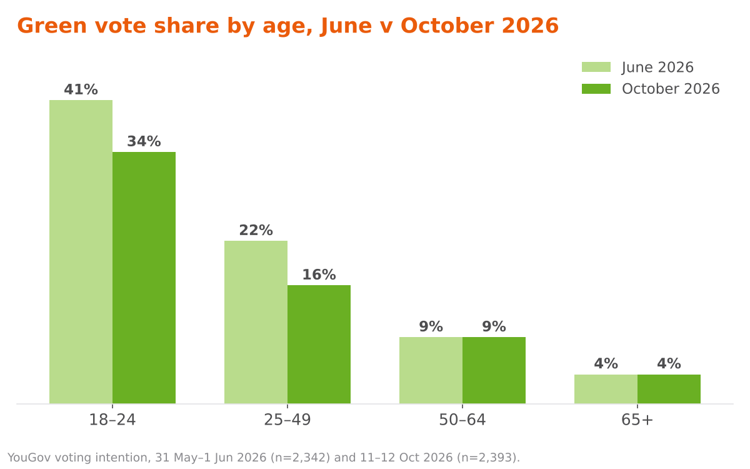
Green vote share by age band, June against October 2026. YouGov voting intention, 31 May to 1 June and 11 to 12 October 2026.
The loss is mostly young men. Green support among men fell from 15% to 8% while among women it only slipped from 16% to 14%, and More in Common finds women under 25 are still a Green-first group at 43%. The practical point is that the Green vote remains concentrated in the young, in flats and in rented housing, and it remains almost invisible to our canvass because those voters are out when we knock, hard to reach at home and often not the person who answers the door. Our data will say they are not there right up until polling day.
Who gets their political news where
The best single table for campaigners is the British Social Attitudes survey’s question on where people get their political news. Social media is the main source for 58% of under-35s and 8% of over-55s. Television is the main source for 46% of over-55s and 12% of under-35s. Newspapers are the main source for 20% of over-55s and 5% of under-35s. The same survey found that 44% of people whose main source is social media did not vote in 2024, against 18% of everyone else, so the voters we cannot see in our canvass are also the ones least likely to turn out unless something mobilises them.
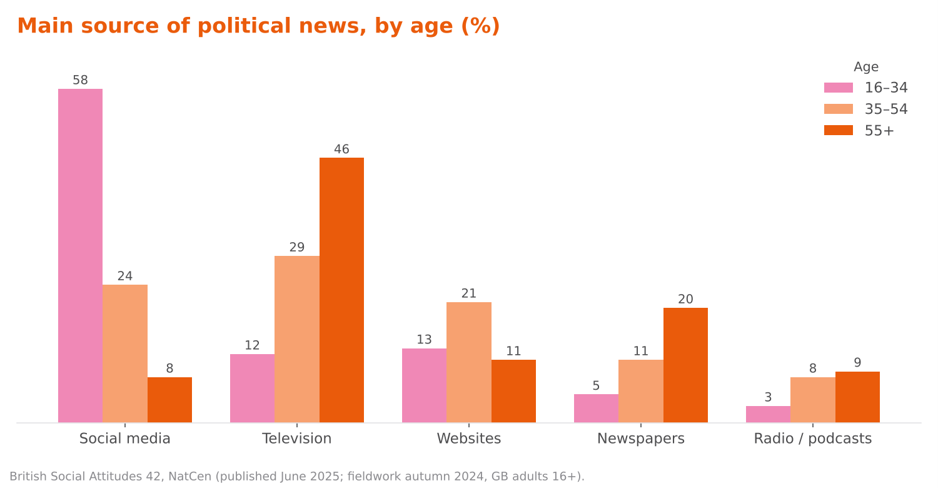
Main source of political news by age band. British Social Attitudes 42, NatCen, published June 2025 (fieldwork autumn 2024).
Ofcom’s 2026 figures fill in the platforms. Online (82%) has now overtaken television (79%) as the country’s main news platform. Among 16 to 24s, 78% got news from social media or video platforms in the past month, against 22% of over-75s. TikTok reaches 83% of 16 to 24 social media users and 7% of over-75s; Snapchat 78% and 3%. The one place the pattern reverses is Facebook, used by 81% of online over-75s and 55% of 16 to 24s. That reversal is why the local air war on Facebook still reaches older voters and misses younger ones. WhatsApp reaches nine in ten of every age group.
Two cautions. Only 7% of UK adults use TikTok for news, far fewer than people assume, and Facebook (39%) and YouTube (33%) remain the biggest news platforms. And the audiences differ by party as well as by age: Reform voters watch as much television as anyone, are far more likely to watch GB News and are on Facebook rather than TikTok, while Green voters are the heaviest social media news users of any party and lean to Instagram, TikTok and podcasts. For reaching younger voters, Facebook video and Instagram vertical video are far more targetable than TikTok, and the ground game is stalls, schools, colleges, workplaces and events, the places that home contact never reaches.
What to do about it
None of this replaces the basics. Door knocking and delivery still work better than anything else, our defence rate is the best of any party, and volume, repetition and squeeze still win elections. What follows is layered on top of those.
Fix the mechanics first. We leave about two points of national vote share on the table by not standing everywhere, and Reform stands everywhere. Close the candidate footprint gap, rebuild the postal vote, and plan for higher turnout, because the winning post has moved. Build canvass volume to 30 to 50% of the ward, then learn to run a switch analysis: the flows reversed in a single summer and you cannot see that in raw totals.
One message won’t do. The same leaflet cannot squeeze an older estate ward, a young inner-city ward and a ward full of returning Labour voters. Segment the ward first, using the demographic predictors, then choose the message. Squeeze is still king, but it now runs in many directions.
Action is the message. Voters believe proof, not promises. Every leaflet needs a specific thing you did, and if a piece of paper does not carry your message, do not print it.
Beating Reform is canvass volume, a clear Reform-versus-Lib-Dem squeeze on every piece of paper, literature volume, a named and visible local candidate, an action focus in which their council record is now your contrast, postal votes as your hedge against their on-the-day surge, and a plan for high turnout. Expect a paid Reform organiser in your patch within a year. Do not rebut everything, do not complain about their tone, do not lose your own message, and do not read silence as absence. We win by telling our story, not by fact-checking theirs.
Beating the Greens is reaching them where they are, co-opting their values with our delivery (“we share your values, and we get it done”), letting turnout and postal votes do some of the work, attacking in disappointment while staying reasonable, and winning back our own switchers: seven in ten Liberal Democrat voters who went Green say they could come home. Do not assume they have gone because the polls fell, do not defend the status quo, do not just do leaflets, do not ever let them in, and do not fight them where you can squeeze them.
Five things for Monday morning. Close the candidate footprint gap and stand everywhere you can. Build the canvass volume, then learn to run a switch analysis. Recruit and retain postal voters. Expect a paid Reform organiser in your patch within a year. And remember first principles: squeeze is king, and now it runs in many directions.